Introduction
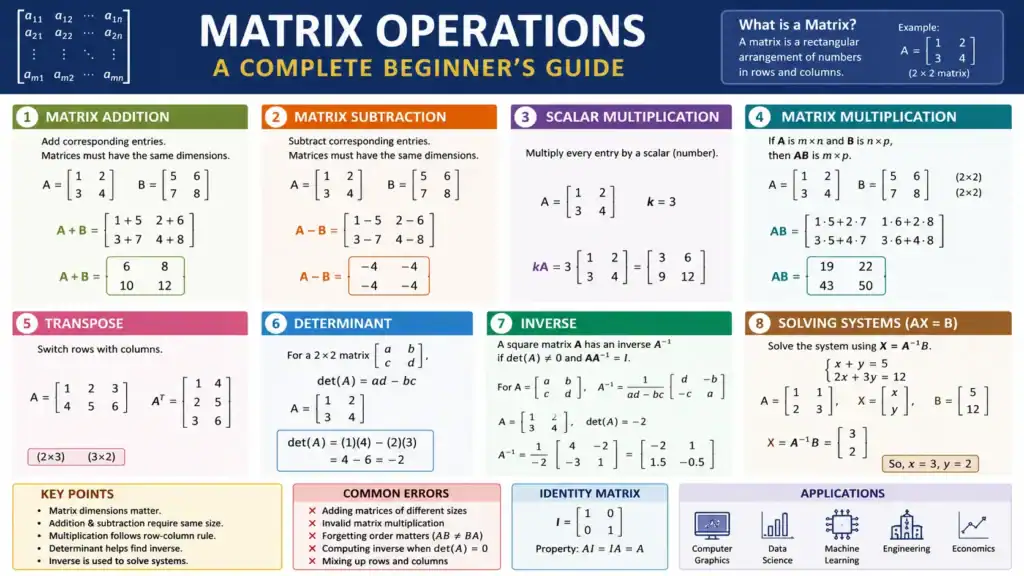
Matrices are rectangular arrays of numbers that serve as the foundational language of linear algebra, computer graphics, 3D game engines, machine learning, physics simulations, and data science. However, many students find matrix operations unintuitive because matrix multiplication and division follow entirely different rules than ordinary scalar arithmetic.
This comprehensive guide breaks down every core matrix operation with clear visual rules and worked examples. Follow along and test your matrices live using the TI-84 Calculator Online.
Calculate Matrix Operations Online
Perform matrix addition, multiplication, determinants, and inverses instantly on our browser-based simulator.
What Is a Matrix?
A matrix is a grid of numbers organized into (m) rows (horizontal) and (n) columns (vertical), denoted as an (m times n) dimension matrix:
[ A = begin{bmatrix} 1 & 2 3 & 4 end{bmatrix} quad (text{Dimension: } 2 times 2) ]
1. Matrix Addition & Subtraction
Rule: Both matrices must have the exact same dimensions. You simply add or subtract corresponding entries:
[ begin{bmatrix} 1 & 2 3 & 4 end{bmatrix} + begin{bmatrix} 5 & 6 7 & 8 end{bmatrix} = begin{bmatrix} 1+5 & 2+6 3+7 & 4+8 end{bmatrix} = begin{bmatrix} 6 & 8 10 & 12 end{bmatrix} ]
2. Scalar Multiplication
Rule: To multiply a matrix by an ordinary scalar number (k), multiply every individual entry by (k):
[ 3 begin{bmatrix} 1 & 2 3 & 4 end{bmatrix} = begin{bmatrix} 3(1) & 3(2) 3(3) & 3(4) end{bmatrix} = begin{bmatrix} 3 & 6 9 & 12 end{bmatrix} ]
3. Matrix Multiplication (Row-by-Column)
Dimension Condition: To multiply (A_{m times k} times B_{k times n}), the number of columns in (A) must equal the number of rows in (B). The resulting matrix will have dimensions (m times n).
Calculation Process: Each element in the product is the dot product of row (i) from (A) and column (j) from (B):
[ begin{bmatrix} 1 & 2 3 & 4 end{bmatrix} begin{bmatrix} 5 & 6 7 & 8 end{bmatrix} = begin{bmatrix} (1cdot5 + 2cdot7) & (1cdot6 + 2cdot8) (3cdot5 + 4cdot7) & (3cdot6 + 4cdot8) end{bmatrix} = begin{bmatrix} 19 & 22 43 & 50 end{bmatrix} ]
Important: Matrix multiplication is not commutative ((AB neq BA)).
4. Matrix Transpose ((A^T))
The transpose switches the rows and columns of a matrix:
[ begin{bmatrix} 1 & 2 & 3 4 & 5 & 6 end{bmatrix}^T = begin{bmatrix} 1 & 4 2 & 5 3 & 6 end{bmatrix} ]
5. Determinant of a 2×2 Matrix
For any square (2 times 2) matrix (begin{bmatrix} a & b c & d end{bmatrix}), the determinant is:
[ det(A) = ad – bc ]
For example, for (begin{bmatrix} 1 & 2 3 & 4 end{bmatrix}), (det(A) = (1)(4) – (2)(3) = 4 – 6 = -2).
6. Matrix Inverse ((A^{-1}))
The inverse matrix satisfies (A A^{-1} = I) (the identity matrix). For a (2 times 2) matrix:
[ A^{-1} = frac{1}{det(A)} begin{bmatrix} d & -b -c & a end{bmatrix} = frac{1}{-2} begin{bmatrix} 4 & -2 -3 & 1 end{bmatrix} = begin{bmatrix} -2 & 1 1.5 & -0.5 end{bmatrix} ]
If (det(A) = 0), the matrix is singular and has no inverse.
Frequently Asked Questions
How do I calculate matrices on a graphing calculator?
See our step-by-step tutorial on How to Use Matrices on a TI-84 Calculator.
Summary
Mastering matrix addition, scalar multiplication, dot-product multiplication, determinants, and inverses opens the door to linear algebra and data science. Test these concepts live on our free online TI-84 calculator!

Dr. Vivienne Blackwell is a mathematics and educational technology specialist focused on TI-84 calculator online tools, graphing calculator simulations, algebra, calculus, and statistics problem-solving systems. She creates structured and optimised guides that explain how to use TI-84 emulators and online calculator platforms for accurate equation solving, function graphing, and exam-focused mathematical analysis.